
India Norway Relations: A Green Partnership Growing Stronger in 2026
India and Norway, two democracies with distinct geographies, are forging a robust "Green Strategic Partnership" focused on sustainability, technology, and shared global interests.
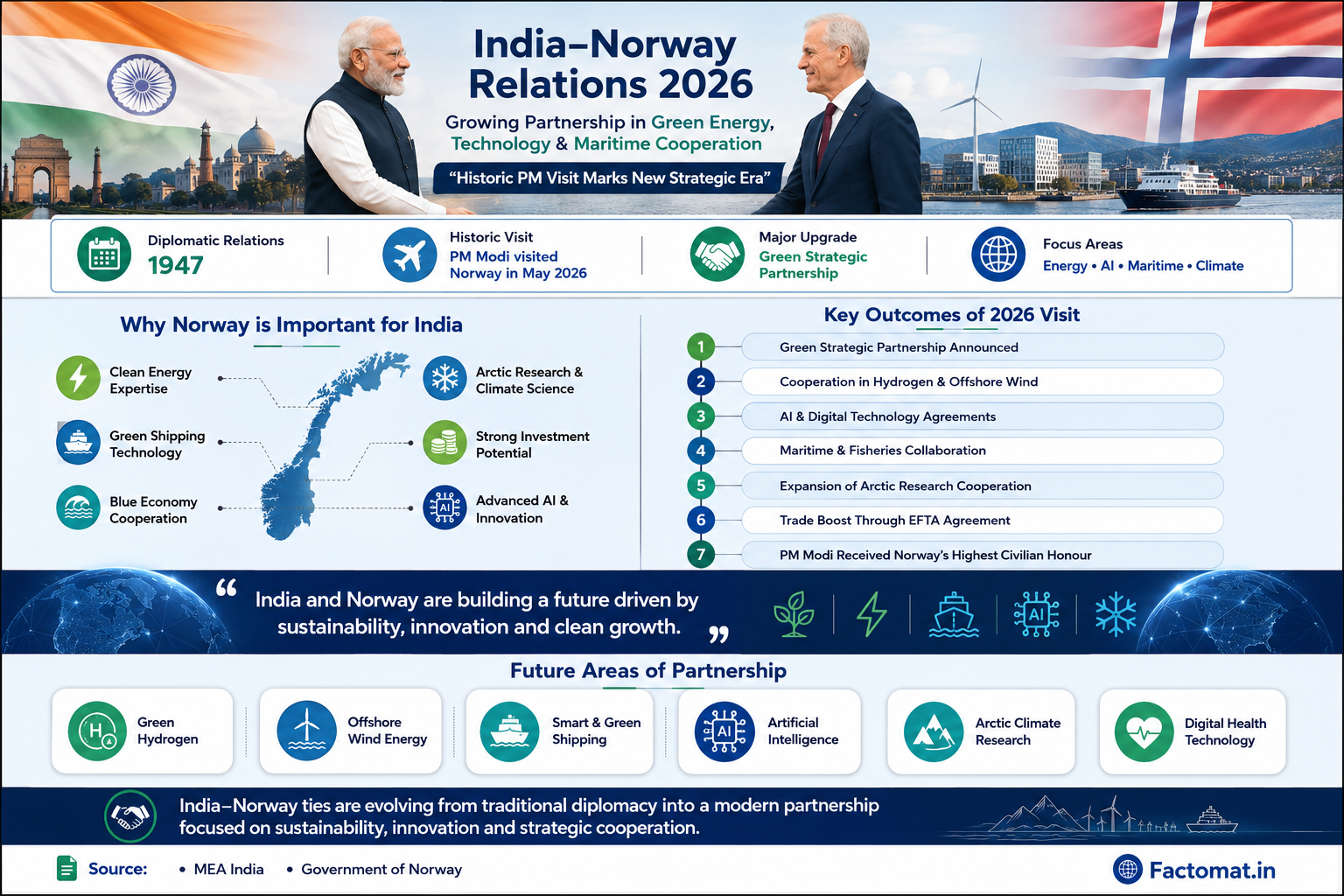
Historical Trajectory of Relations
Diplomatic ties between India and Norway were formally established in 1947, immediately following India's independence. Norway was among the first European nations to acknowledge India's sovereignty, laying the groundwork for a relationship rooted in mutual respect. For several decades, the engagement remained cordial but largely concentrated on specific sectors such as maritime cooperation, fisheries, and shipping. Development partnerships and cultural exchanges also formed a significant part of this early phase, fostering goodwill between the two nations.
Norway's consistent emphasis on peace, environmental stewardship, and humanitarian efforts has historically resonated well within India, contributing to a positive perception. Concurrently, India's emergence as a rapidly growing economy and an influential global player has progressively heightened Norway's strategic interest in the South Asian region. This evolving dynamic set the stage for a more comprehensive and strategic engagement, moving beyond traditional diplomatic interactions to address contemporary global challenges and opportunities.
Norway's Strategic Importance for India
Despite its relatively small population, Norway stands out as one of the world's wealthiest and most technologically advanced nations. Its unparalleled expertise in critical areas such as offshore energy, green shipping, hydropower, Arctic research, and carbon capture technology makes it an invaluable partner for India. These capabilities are directly relevant to India's ambitious national goals, particularly its transition towards a clean energy economy and sustainable infrastructure development.
For India, Norway offers crucial support in developing its blue economy, advancing green hydrogen initiatives, and fostering climate-resilient growth. Norway's leadership in maritime innovation and sustainable resource management provides a blueprint and technological solutions that can accelerate India's own green transition. Furthermore, Norway manages one of the world's largest sovereign wealth funds, accumulated from its petroleum revenues, positioning it as a significant global investor. This financial strength, combined with its technological prowess, makes Norway a key partner for India in securing investments and advanced technologies essential for its sustainable development agenda.
PM Modi's Historic 2026 Visit
Prime Minister Narendra Modi's visit to Oslo on May 18 19, 2026, marked a pivotal moment in India Norway relations. This was PM Modi's inaugural visit to Norway and, notably, the first by an Indian Prime Minister in 43 years, underscoring its historical significance. The visit was part of a broader five-nation European tour, highlighting India's proactive engagement with key European partners. During his stay, PM Modi engaged in bilateral discussions with Norwegian Prime Minister Jonas Gahr St re, focusing on strengthening cooperation across various sectors.
A key highlight of the visit was PM Modi's participation in the 3rd India Nordic Summit. This summit provided a platform for India to engage collectively with Nordic countries, including Norway, on issues of mutual interest such as innovation, green transition, and sustainable development. The visit culminated in the official elevation of the India Norway relationship to a "Green Strategic Partnership," signifying a shared commitment to environmental sustainability and climate action as central pillars of their bilateral ties.
Outcomes of the Green Strategic Partnership
The elevation to a "Green Strategic Partnership" in May 2026 formalized India and Norway's commitment to deeper collaboration in critical environmental and energy sectors. Both nations agreed to intensify cooperation in clean energy, climate resilience, green shipping, offshore wind energy, hydrogen energy, and carbon capture technologies. This alignment is particularly significant as it leverages Norway's advanced expertise in sustainable technologies with India's ambitious targets for renewable energy expansion and climate action. The partnership aims to facilitate technology transfer, joint research, and capacity building, accelerating India's transition towards a low-carbon economy.
Beyond environmental cooperation, the visit also emphasized strengthening trade and investment relations. This was significantly bolstered by the implementation of the EFTA India Trade and Economic Partnership Agreement (TEPA), which came into force in October 2025. The TEPA is expected to catalyze increased Norwegian investments in India, fostering job creation, expanding technology transfers, and improving market access for goods and services. This comprehensive agreement provides a robust framework for enhancing economic ties, ensuring that the "Green Strategic Partnership" is supported by a strong foundation of trade and investment.
Exam Relevance for Aspirants
For UPSC, SSC, and Banking aspirants, understanding India Norway relations is crucial, especially the nuances of the "Green Strategic Partnership." This topic falls under International Relations (GS Paper II for UPSC) and current affairs. Questions may focus on the historical context of diplomatic ties, the specific areas of cooperation (e.g., blue economy, green hydrogen, carbon capture), and the significance of recent high-level visits like PM Modi's 2026 trip. Aspirants should be aware of the EFTA India TEPA and its implications for trade and investment.
Key terms like "Green Strategic Partnership," "Blue Economy," and "Carbon Capture and Storage (CCS)" are important. Knowledge of Norway's strengths in offshore energy and sustainable technologies, and how they align with India's climate goals (e.g., Net Zero by 2070), is also vital. Questions could also touch upon India's broader engagement with Nordic countries through forums like the India Nordic Summit. Understanding the mutual benefits and strategic importance of this partnership for both nations will be key to answering analytical questions.
Important Keywords Explained
- Green Strategic Partnershipconcept
- A bilateral framework adopted by India and Norway in 2026 to deepen cooperation in clean energy, climate resilience, green shipping, offshore wind, hydrogen energy, and carbon capture technologies, aligning with global sustainability goals.
- Blue Economyconcept
- Sustainable use of ocean resources for economic growth, improved livelihoods, and ocean ecosystem health. It encompasses sectors like fisheries, shipping, marine tourism, and offshore renewable energy, crucial for coastal nations like India and Norway.
- EFTA India TEPAact
- The Trade and Economic Partnership Agreement between India and the European Free Trade Association (EFTA) states (Iceland, Liechtenstein, Norway, Switzerland), which entered into force in October 2025, aiming to boost trade, investment, and technology transfer.
- Carbon Capture and Storage (CCS)concept
- A technology that captures carbon dioxide (CO2) emissions from industrial sources or power generation, preventing them from entering the atmosphere, and then transports and stores them underground in geological formations.
Additional Facts & Context
- Norway is the world's 3rd largest natural gas exporter and 8th largest oil exporter.
- The Government Pension Fund Global (Norway's sovereign wealth fund) is the world's largest, valued at over $1.5 trillion.
- India is Norway's 2nd largest trading partner in Asia, after China.
- Norway has a coastline of over 100,000 km, including islands, making it one of the longest globally.
Memory Trick
🧠 Remember 'NORWAY' for 'N'ew 'O'pportunities in 'R'enewables, 'W'ealth fund, 'A'rctic research, 'Y'ellow (green) partnership.