
Sufi Movement: Origins, Orders, and Impact in Medieval India
The Sufi movement significantly shaped the religious and cultural landscape of medieval India. Understanding its principles and key figures is crucial for competitive exams.
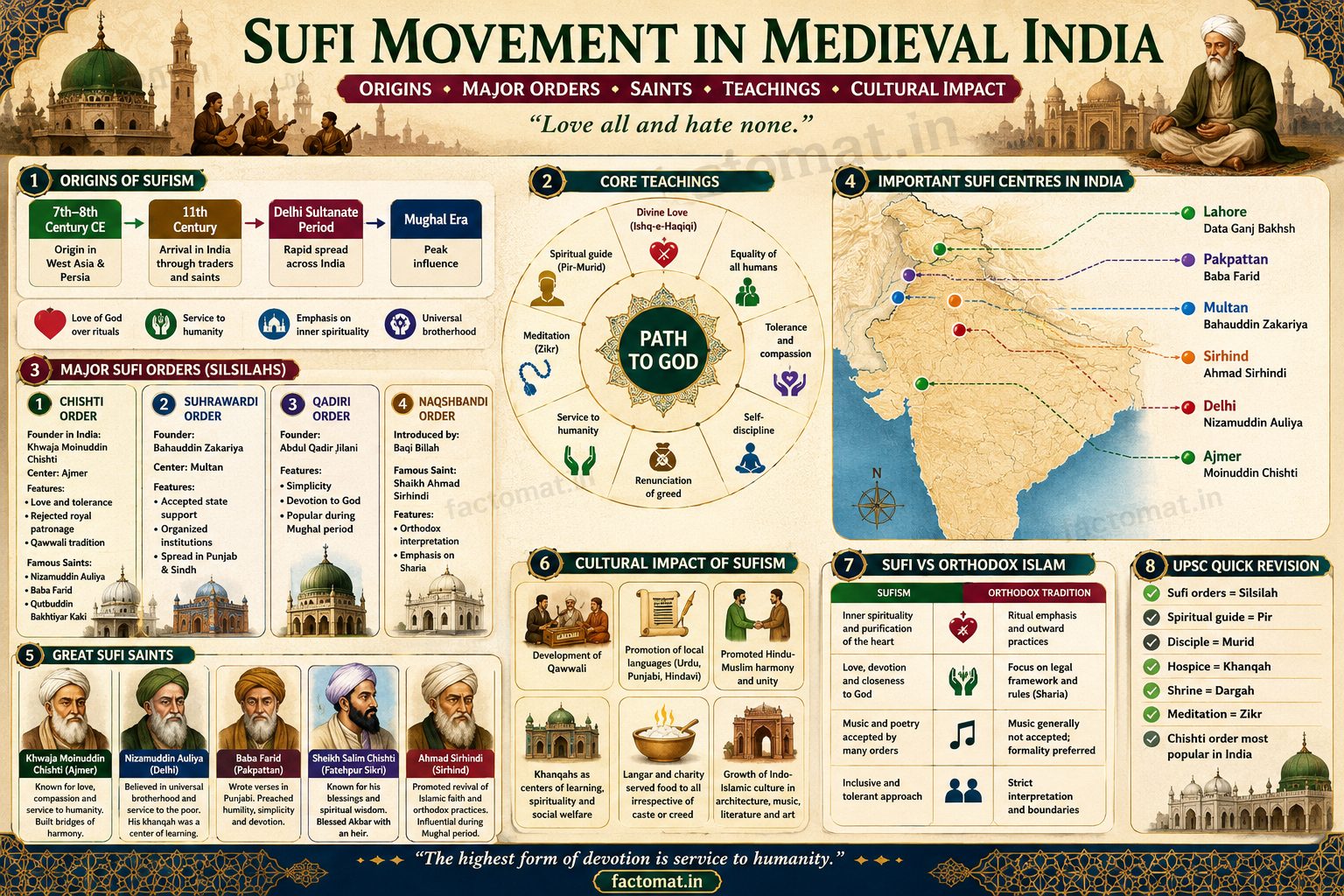
Origins and Philosophy
Sufism is a mystical branch of Islam that emerged in Persia and the Middle East. It emphasizes direct communion with God through asceticism, devotion, and spiritual practices. Sufis sought inner purification and rejected rigid dogmatism. They believed in the oneness of God (Tawhid) and the importance of a spiritual guide (Pir or Murshid). Sufism arrived in India with the establishment of the Delhi Sultanate in the 12th century. It found fertile ground due to its emphasis on love, humanity, and tolerance, which resonated with existing Bhakti traditions. The early Sufis in India were often scholars and missionaries who helped spread Islamic teachings in a more accessible and inclusive manner. They established 'khanqahs' (hospices) and 'dargahs' (shrines) which became centers of spiritual learning and community service.
Major Sufi Orders
Several prominent Sufi orders, known as 'silsilas', flourished in India. The Chishtiya silsila was one of the most influential, founded by Khwaja Muinuddin Chishti in Ajmer in the late 12th century. Its notable saints included Nizamuddin Auliya and Fariduddin Ganjshakar. The Chishtis emphasized love for humanity, simple living, and tolerance. They avoided state patronage and lived among the common people. Another important order was the Suhrawardiya silsila, founded by Sheikh Shihabuddin Suhrawardi. In India, it was popularized by Bahauddin Zakariya in Multan. Unlike the Chishtis, the Suhrawardis accepted state patronage and held positions in the government. The Qadiriya silsila, founded by Abdul Qadir Gilani, was introduced in India by Shah Nimatullah and Makhdum Muhammad Gilani. It gained popularity in the 15th century, especially in Punjab and Sindh. Prince Dara Shikoh, son of Mughal emperor Shah Jahan, was a follower of this order. The Naqshbandiya silsila, founded by Khwaja Bahauddin Naqshband, was introduced in India by Khwaja Baqi Billah. Its most prominent saint was Sheikh Ahmad Sirhindi, who advocated for strict adherence to Islamic law and opposed syncretic practices.
Sufi Practices and Impact
Sufi practices included 'dhikr' (remembrance of God through chanting), 'sama' (spiritual music and dance, especially qawwali), and 'muraqaba' (meditation). These practices aimed to achieve a state of ecstasy and spiritual union. The Sufis played a significant role in promoting communal harmony and bridging the gap between different religious communities. Their message of universal love and brotherhood appealed to people from all walks of life, including Hindus. Many Sufi saints were revered by both Muslims and Hindus. They contributed to the development of regional languages like Punjabi, Sindhi, and Urdu, as their teachings were often conveyed in local dialects. Sufi literature, poetry, and music enriched Indian culture. The 'dargahs' of Sufi saints continue to be important pilgrimage sites, attracting devotees irrespective of their faith, symbolizing the enduring legacy of Sufism in India.
Sufism and Bhakti Movement
The Sufi movement and the Bhakti movement, though distinct, shared many similarities and influenced each other. Both movements emphasized devotion, personal experience of God, and rejected the rigid rituals and caste distinctions prevalent in their respective religions. Both Sufi Pirs and Bhakti saints used local languages to spread their message, making it accessible to the masses. Figures like Kabir and Guru Nanak incorporated elements of both Sufi and Bhakti thought in their teachings. Kabir's verses often speak of a formless God and universal love, echoing Sufi principles. Guru Nanak, the founder of Sikhism, was influenced by both Sufi and Bhakti traditions, advocating for equality and devotion. This interaction led to a rich cultural synthesis and fostered a spirit of mutual understanding and tolerance among different communities in medieval India. The shared emphasis on inner purity and direct experience of the divine created a common ground for dialogue and exchange.
Important Keywords Explained
- Silsilaconcept
- Silsila refers to a chain or lineage of Sufi masters and disciples, forming a specific Sufi order. Each silsila has its own set of spiritual practices, teachings, and a founding saint. Major silsilas in India include Chishtiya, Suhrawardiya, Qadiriya, and Naqshbandiya.
- Khanqahplace
- A khanqah is a Sufi hospice or monastery, serving as a center for spiritual retreat, worship, and education. It also provided shelter and food for travelers and the poor. Sufi saints and their disciples lived and taught in khanqahs, which became important community hubs.
- Dargahplace
- A dargah is a shrine built over the grave of a revered Sufi saint. These sites are considered sacred and attract pilgrims from various faiths seeking blessings and spiritual solace. The dargah of Khwaja Muinuddin Chishti in Ajmer is one of the most famous in India.
- Samaconcept
- Sama is a Sufi practice involving listening to music, chanting, and sometimes dancing (like the whirling dervishes) to achieve a state of spiritual ecstasy and communion with God. Qawwali, a form of devotional music, is a well-known example of sama.
Additional Facts & Context
- Khwaja Muinuddin Chishti arrived in Ajmer around 1192 AD.
- The Chishtiya order was the first major Sufi silsila to be established in India.
- Amir Khusrau, a famous poet, was a disciple of Nizamuddin Auliya.
- The term 'Sufi' is believed to be derived from 'suf', meaning wool, referring to the coarse woolen garments worn by early ascetics.
- The Suhrawardiya silsila was more active in Punjab and Sindh regions.
Memory Trick
🧠 Remember 'CSQN' for the main silsilas: Chishti, Suhrawardi, Qadiri, Naqshbandi. 'C' for Chishti, 'S' for Suhrawardi, 'Q' for Qadiri, 'N' for Naqshbandi.