
Major Soil Types of India: Classification and Characteristics for UPSC SSC
Understanding India's diverse soil types is crucial for competitive exams. Soils are fundamental to agriculture, economy, and environmental studies.
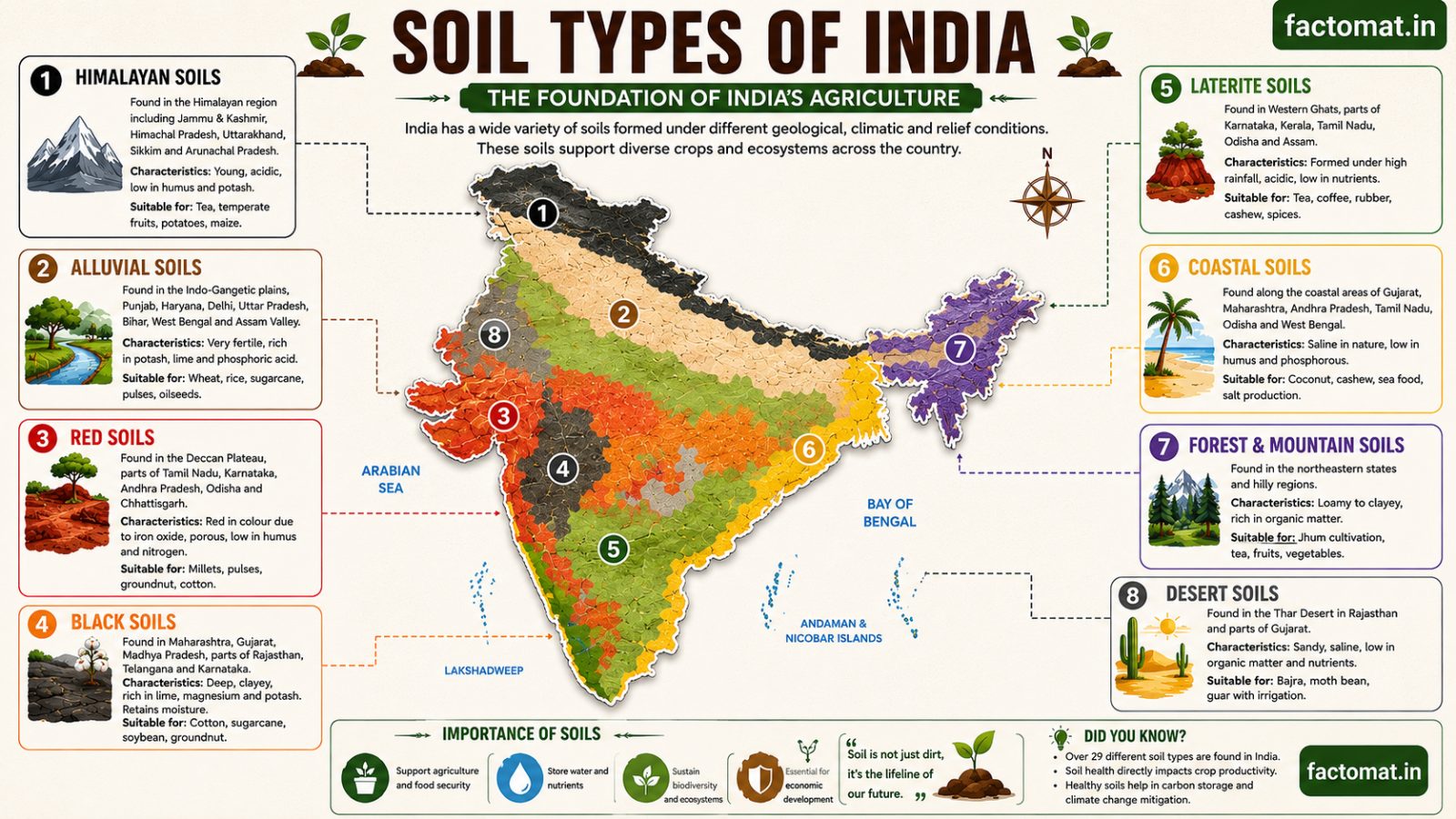
Alluvial Soils
Alluvial soils are the most widespread and fertile soils in India, covering about 40% of the total land area. They are formed by the deposition of silt, sand, and clay carried by rivers from the Himalayas and the Peninsular region. These soils are found extensively in the Northern Plains, from Punjab to West Bengal and Assam, and also in the deltas of the Mahanadi, Godavari, Krishna, and Kaveri rivers. Alluvial soils are rich in potash, phosphoric acid, and lime, making them ideal for growing a variety of crops like wheat, rice, sugarcane, and pulses. They are generally deficient in nitrogen and humus.
There are two main types of alluvial soils: Khadar and Bhangar. Khadar refers to the new, younger alluvium deposited by floods annually, which is highly fertile. Bhangar refers to the older alluvium, found away from the flood plains, which is less fertile and contains calcareous concretions called 'kankars'. The texture of alluvial soils varies from sandy loam to clay, depending on the region and the river system. Their high fertility supports a large population and intensive agriculture across the Indo-Gangetic plains.
Black Soils
Black soils, also known as Regur soils or Black Cotton soils, are characteristic of the Deccan Trap region. They cover large areas of Maharashtra, Madhya Pradesh, Gujarat, Andhra Pradesh, and parts of Tamil Nadu. These soils are formed from the weathering of basaltic rocks and are rich in iron, lime, calcium, potassium, aluminium, and magnesium. They are known for their high clay content, which gives them excellent moisture-retentive capacity, making them suitable for dry farming.
Black soils develop deep cracks during hot, dry weather, which helps in aeration. They become sticky when wet, making ploughing difficult during the monsoon. The self-ploughing characteristic is a unique feature. Cotton is the most important crop grown in these soils, hence the name Black Cotton Soil. Other crops include sugarcane, jowar, wheat, and oilseeds. The dark colour of these soils is attributed to the presence of titaniferous magnetite and humus.
Red and Yellow Soils
Red soils develop on crystalline igneous rocks in areas of low rainfall in the eastern and southern parts of the Deccan Plateau. They are found in parts of Odisha, Chhattisgarh, the southern parts of the Middle Ganga Plain, and along the piedmont zone of the Western Ghats. The red colour is due to the diffusion of iron in crystalline and metamorphic rocks. When these soils are hydrated, they appear yellow.
These soils are generally poor in nitrogen, phosphorus, and humus. They are typically sandy to loamy in texture and are less fertile than alluvial or black soils. With proper irrigation and use of fertilizers, they can support crops like groundnuts, ragi, tobacco, and potatoes. The fertility varies greatly depending on the location and parent rock material. They are often found in areas with moderate to high rainfall.
Laterite Soils
Laterite soils develop in areas with high temperature and heavy rainfall, leading to intense leaching. This process removes silica and leaves behind iron and aluminium compounds. They are found in the Western Ghats, Eastern Ghats, parts of Karnataka, Kerala, Tamil Nadu, Madhya Pradesh, and the hilly areas of Assam and Odisha. These soils are generally poor in organic matter, nitrogen, potash, and lime, making them less fertile for cultivation.
Laterite soils are coarse and crumbly. They are suitable for growing plantation crops like tea, coffee, cashew nuts, and rubber, especially after proper manuring. When wet, they are soft, but they become hard and brick-like when dry, making them useful for building materials. The high iron oxide content gives them a reddish colour. Bauxite, an ore of aluminium, is often found in laterite regions.
Arid and Saline Soils
Arid soils, also known as desert soils, are found in arid and semi-arid regions, primarily in western Rajasthan, parts of Gujarat, and southern Punjab. These soils are characterized by a dry climate, high temperatures, and very low humus content due to sparse vegetation. They are sandy in texture and saline in nature. The salt content is so high in some areas that common salt is obtained by evaporating the water.
Due to the dry climate, high temperature, and rapid evaporation, these soils lack moisture and humus. The lower horizons of the soil are often occupied by 'kankar' layers, which restrict water infiltration. With proper irrigation, these soils can be made cultivable for drought-resistant crops like bajra, jowar, and pulses. Saline soils, also called Usara soils, are found in arid and semi-arid regions, and also in waterlogged and swampy areas, particularly in parts of Uttar Pradesh, Haryana, and Punjab. They are infertile due to high salt content.
Important Keywords Explained
- Regur Soilconcept
- Regur soil is another name for Black Soil, primarily found in the Deccan Trap region of India. It is formed from the weathering of basaltic rocks and is rich in minerals like iron, lime, and magnesium. Known for its high clay content and excellent moisture retention, it is ideal for growing cotton, hence also called Black Cotton Soil. It develops deep cracks when dry, aiding aeration.
- Khadarconcept
- Khadar refers to the new, younger alluvial soil found in the floodplains of rivers. It is deposited annually by floodwaters, making it extremely fertile and renewed regularly. Khadar soils are typically fine-grained and rich in silt, supporting intensive agriculture, especially rice and wheat cultivation, in the Indo-Gangetic plains.
- Lateritizationconcept
- Lateritization is a soil-forming process that occurs in tropical and subtropical regions with high temperatures and heavy rainfall. It involves the intense leaching of silica and other soluble bases from the soil, leaving behind a residue rich in iron and aluminium oxides. This process results in the formation of laterite soils, which are typically acidic and less fertile.
Additional Facts & Context
- The Indian Council of Agricultural Research (ICAR) classifies Indian soils into 8 major types and several sub-types.
- Peaty soils are found in areas of heavy rainfall and high humidity, with rich organic matter content.
- Forest soils are found in forest areas and vary in texture and structure depending on the mountain environment.
- The pH value of soils in India ranges widely, from acidic (below 7) to alkaline (above 7).
- Soil erosion is a major problem affecting agricultural productivity in many parts of India.
Memory Trick
🧠 Remember 'BARF' for major soils: Black, Alluvial, Red, Laterite, Forest, Arid. Connect them to regions and crops.