
Chola Maritime Empire: Naval Power and Southeast Asian Influence
The Chola dynasty was a powerful South Indian empire known for its strong navy and extensive maritime trade. Understanding their naval prowess is crucial for competitive exams.
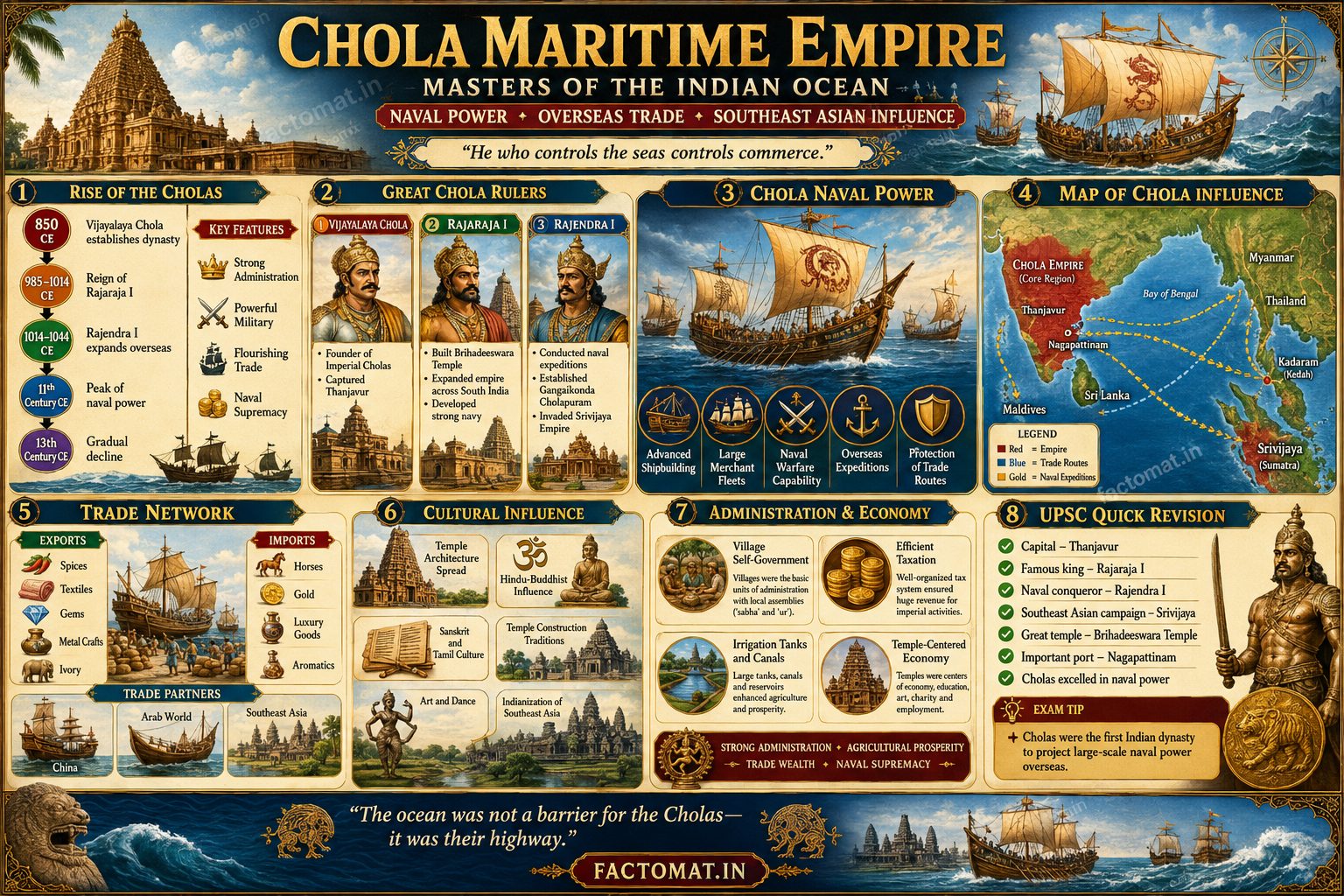
Rise of Chola Power
The Chola dynasty emerged as a significant power in South India around the 9th century CE. Their heartland was the fertile Kaveri delta. Under rulers like Vijayalaya Chola, who founded the imperial Chola line in 850 CE by capturing Thanjavur, the kingdom began to expand. Parantaka I further consolidated their rule, defeating the Pandyas and the Rashtrakutas. However, it was Rajaraja I (985-1014 CE) and his son Rajendra I (1014-1044 CE) who transformed the Cholas into a formidable maritime empire. Their strategic vision recognized the importance of naval strength for both trade and territorial expansion across the Indian Ocean.
Naval Expeditions and Conquests
Rajaraja I initiated the Chola naval expansion by conquering Sri Lanka (Ceylon), bringing its northern part under Chola control. He also captured the Maldives, strategically important islands for controlling trade routes. His son, Rajendra I, took Chola naval power to its zenith. In a remarkable expedition around 1025 CE, Rajendra I launched a massive naval campaign against the Srivijaya Empire in Southeast Asia. Srivijaya controlled crucial sea lanes in the Strait of Malacca. The Chola navy successfully raided and conquered several territories of Srivijaya, including Kedah (Kadaram) and parts of Sumatra and the Malay Peninsula. This expedition was not aimed at permanent occupation but rather at asserting Chola dominance over trade routes and punishing Srivijaya for obstructing Chola trade interests.
Trade and Cultural Exchange
The Chola maritime empire facilitated extensive trade networks across the Indian Ocean. Chola merchants traded with Southeast Asia, China, and the Middle East. They exported textiles, spices, jewels, and camphor, while importing horses, elephants, and luxury goods. The control over sea lanes ensured the safety and prosperity of these trade routes. This period also saw significant cultural exchange. Indian culture, particularly Hinduism and Buddhism, spread to Southeast Asia through these maritime connections. Chola art and architecture, characterized by grand temples like the Brihadeeswarar Temple, also influenced regional styles. The Chola state actively supported merchant guilds and maritime activities, recognizing their economic importance.
Administration and Legacy
The Chola administration was highly organized, with a strong central government and well-defined local self-governance through village assemblies (Ur and Sabha). The revenue system was efficient, primarily based on land tax. The Chola navy was a professional force, well-equipped and trained, playing a crucial role in maintaining the empire's influence. The legacy of the Chola maritime empire is profound. They demonstrated the strategic importance of naval power in ancient India, established India's presence in Southeast Asia, and fostered a vibrant period of trade and cultural diffusion. Their achievements in naval warfare and overseas expansion remain a significant chapter in Indian history.
Important Keywords Explained
- Srivijaya Empireplace
- An influential thalassocratic (maritime) Malay empire based on the island of Sumatra, Indonesia, which influenced much of Southeast Asia. It controlled the Strait of Malacca and was a major trading power before being challenged by the Cholas.
- Rajaraja Iperson
- One of the greatest emperors of the Chola dynasty, who reigned from 985 to 1014 CE. He laid the foundation for the Chola maritime empire by conquering Sri Lanka and the Maldives and building the magnificent Brihadeeswarar Temple.
- Rajendra Iperson
- Son of Rajaraja I, who ruled from 1014 to 1044 CE. He expanded the Chola Empire to its greatest extent, including a famous naval expedition against the Srivijaya Empire and a march to the Ganges, earning him the title 'Gangaikondachola'.
- Thalassocracyconcept
- A state or empire whose power primarily resides in its naval strength and control over maritime trade routes, rather than extensive land territory. The Chola and Srivijaya empires are examples of thalassocracies.
Additional Facts & Context
- The Brihadeeswarar Temple at Thanjavur was completed around 1010 CE.
- The Chola navy had an estimated strength of over 100,000 men during its peak.
- Rajendra I's expedition to the Ganges in North India occurred around 1019-1022 CE.
- The Chola period saw the construction of over 100 major temples.
- The Chola dynasty ruled for over 1500 years, from ancient times to the 13th century CE, with the Imperial Cholas dominating from 850 CE to 1279 CE.
Memory Trick
🧠 Remember 'Raja-Rajendra, Reach-Regions' Rajaraja I started reaching Sri Lanka, Rajendra I reached further to Srivijaya (Southeast Asian regions).